Most people who look for a Panchakarma retreat Europe are not looking for more discipline. They are looking for a way out of the pressure that has already exhausted them.
Many people who come to Detox Croatia have pushed themselves for too long. They have worked under pressure, carried responsibility, slept poorly, lived through stress, travelled too much, managed people, companies, families, emotions and expectations. By the time they start looking for a detox retreat, the body is often not simply "dirty" or overloaded. It is exhausted.
This is where modern detox culture often gives the wrong answer.
It tells people to fast harder, cleanse harder, sweat more, restrict more, take colder juices, follow stricter rules and prove more discipline.
But many people are already exhausted when they arrive, and then they exhaust themselves even more.
In my experience, what they often need first is not more pressure. They need rest, quiet, warmth, food, oil, rhythm and the feeling that somebody is actually guiding them.
At Detox Croatia, detox is not treated as punishment. It is a guided Ayurvedic process that has to fit the real condition of the client in front of us.
Why Exhausted People Are Drawn to Aggressive Detox
When people feel bloated, foggy, heavy, inflamed or uncomfortable in their own body, they naturally want a strong solution. They want to feel clean again. They want the abdomen to feel lighter, the mind clearer, the skin calmer, the sleep deeper and the energy to return.
That is why fasting, juice cleansing, sauna protocols, strict food plans and harsh detox programs can feel attractive. They give the impression that something decisive is finally happening. But the important question is not whether a method looks strong. The question is whether this particular body can tolerate it now.
The Biggest Mistake in Modern Detox Culture
The biggest mistake in modern detox culture is that exhausted people are pushed into more exhaustion.
Many clients do not arrive with excess strength. They arrive with poor sleep, sensitive digestion, nervous tension, irregular appetite, unstable bowels and a mind that has been controlling everything for too long.
Then someone gives them another project to survive.
More fasting. More rules. More cleansing. More discipline. More effort.
For some bodies, this becomes another stressor.
In Ayurveda, the condition of the person matters more than the name of the protocol. A detox is not intelligent because it is difficult. It is intelligent when the timing, method and intensity are right.
Detox for an Exhausted Body Needs a Different Logic
Some clients do not need a strong detox immediately. They need to stop fighting.
At the beginning, I often tell clients to try to relax into the process and not control everything with the mind. The mind can block the process when it tries to manage every sensation, every symptom and every small change in the body.
This sounds simple, but it is often the hardest part.
Many people come from lives where they are responsible for everything. They are used to deciding, managing, analysing and controlling. When they come to a retreat, the first medicine is sometimes the experience that they do not have to hold everything together for a few days.
Warm food. Oil therapies. Gentle steam. Early nights. Walking. Silence. Fewer decisions. A steady daily rhythm.
From the outside, this can look too simple.
For an exhausted nervous system, it can be exactly what was missing.
A depleted person does not need only cleaning. A depleted person needs to be restored.
Why Daily Presence Changes the Process
One of the biggest things I learned from leading retreat programs is that the presence and calm of the practitioner and therapist can change how quickly the client begins to recover.
This is difficult to explain until you see it.
When the person feels safe, the nervous system stops defending so strongly. Digestion often changes. Sleep changes. The face softens. The abdomen releases. The person breathes differently.
This is why education during the retreat is not a lecture. It is constant practical guidance.
We speak about food, rhythm, digestion, sleep, bowel movements, emotional pressure, small reactions during therapy and how to live more easily after returning home. The client does not have to understand Ayurveda as a system. They need to understand what their own body is showing them.
For many people, this is the first time someone has watched the whole pattern instead of one isolated symptom.
This is why Detox Croatia is built around daily presence, small groups and continuous adjustment, not around a fixed detox schedule.
Why Rest Alone Is Often Not Enough
A normal holiday or spa weekend can help, but passive rest often does not change the pattern that created exhaustion.
A person can be by the sea and still remain internally tense. They can be in a beautiful room and still sleep lightly. They can have free time and still feel that the body is holding pressure.
Real rest is not only a location. It is a state of the body, mind and senses.
That is why we do not rely only on the setting. We use rhythm, warm food, oil therapies, simple routines, daily observation and fewer decisions to help the nervous system stop defending.
This is also why many people who say "I rested, but I did not recover" need a different kind of support. More on this in Why Rest Is No Longer Enough.
What Ayurveda Does Before Deeper Cleansing
Ayurveda does not begin with the idea that everyone should receive the same detox.
The first step is assessment.
We look at Agni (digestive fire, or digestive intelligence), Ama (unprocessed residue from incomplete digestion), bowel rhythm, appetite, sleep, strength, emotional state, age, medical history and the balance of Vata, Pitta and Kapha.
Vata is the Ayurvedic principle of movement, dryness, coldness and nervous system activity. Pitta is the Ayurvedic principle of heat, acidity, metabolism and transformation. Kapha is the Ayurvedic principle of structure, heaviness, stability and lubrication.
These principles matter because two clients can describe the same symptom and need completely different support.
One person with heaviness may need stimulation. Another person with the same heaviness may be depleted underneath. One person may tolerate cleansing. Another may first need oil, food and rest.
This is why fixed detox programs often fail. They follow the protocol more than the person.
At Detox Croatia, we always investigate what to do, how to do it, when to do it and what needs to change as the client changes.
Snehapana as Preparation Before Deeper Cleansing
Snehapana (internal oleation with ghee) is one of the classical Ayurvedic methods used to prepare the body before deeper cleansing when appropriate.
In the Ayurvedic model of Panchakarma, ghee is used to support internal oleation. Traditionally, it is understood to bind fat soluble toxins, including heavy metals and environmental pollutants, and draw them from peripheral tissues towards the digestive tract. This is an Ayurvedic detox principle, not a medical chelation claim.
The important word is preparation.
Snehapana is not simply drinking ghee for a fixed number of days because a protocol says so. The body has to show signs that oleation is happening properly. Ayurveda describes clinical signs that suggest when the body has received enough internal oleation and when accumulated material has moved toward the gastrointestinal tract.
Only then can deeper cleansing be considered.
This is one of the main differences between classical Ayurvedic detox and many modern cleansing trends. The process is not based only on willpower or calendar days. It is based on observation.
Virechana Only When the Body Is Ready
Virechana (therapeutic purgation) is a classical Ayurvedic cleansing procedure that may be used when the body is properly prepared and when the person is suitable for it.
In practice, it involves specific herbal preparations that stimulate repeated bowel movements in a controlled setting. The aim in Ayurveda is to eliminate accumulated material through the digestive tract after preparation with oleation and warmth.
This is not the same as taking a random laxative at home. In Panchakarma, Virechana comes after preparation. We look at appetite, strength, bowel rhythm, sleep, dryness, heat, emotional stability and the signs that oleation has done what it needs to do. If those signs are not there, forcing purgation can be too much.
Clients often describe a feeling of physical and mental lightness after properly guided Virechana. But this does not mean it should be done casually.
If the body is too weak, dry, unstable, dehydrated or unprepared, strong purgation is not intelligent. It is not a weekend experiment. It is not a punishment for overeating. It is not something to do because a person wants dramatic results.
The right question is not: "Can we do Virechana?"
The right question is: "Is this person ready for Virechana now?"
If the answer is no, the gentler approach is the stronger decision.
Basti and the Nervous System
Basti (medicated Ayurvedic enema, or therapeutic enema) is one of the most important procedures in classical Ayurveda, especially where Vata imbalance, the colon, dryness, nervous system activity and deeper exhaustion are involved.
In Ayurvedic practice, Basti can include combinations of herbal decoctions, ghee, oils, salts, honey and other substances, depending on the individual situation. The formula is not chosen mechanically.
Before deciding on Basti, I observe the client's bowel rhythm, abdominal tension, dryness, sleep, anxiety level, appetite, strength and response to previous therapies. Sometimes the abdomen tells more than the questionnaire. Sometimes the pulse, the tongue, the skin and the emotional tone show that the body first needs softening, not stronger cleansing.
This is where daily presence matters.
Basti is not simply a procedure on a schedule. It is adjusted according to what the body is showing that day. One client may need more oil. Another may need a different herbal combination. Another may not be ready at all.
Traditionally, Basti is seen as a way to work through the colon while influencing deeper systems of the body. At Detox Croatia, it is approached as an Ayurvedic practice, not as a medical cure. It may support digestion, elimination, nervous system balance and the broader Panchakarma process when appropriate.
For some clients, Basti can be central. For others, it is too much too soon. The difference is assessment.
When We Choose Not to Detox Strongly
One of the most important signs of a serious retreat is the ability to say: not now.
Not every client should be pushed into strong cleansing.
If a person is too depleted, dry, anxious, unstable, weak, underweight, sleep deprived, emotionally fragile or medically complex, the right approach may be gentle support first. This can include warm food, oil therapy, rest, simple routines, digestive support, sleep rhythm, light movement and Rasayana.
Rasayana (Ayurvedic rejuvenation and rebuilding therapy) focuses on rebuilding strength, tissue nourishment, clarity and vitality through food, herbs, lifestyle and long term restoration.
For some clients, this is the missing part.
They have tried cleansing many times, but they have not rebuilt. They have reduced food, restricted diets, taken supplements, tried fasting and forced discipline. But their system still does not feel stable.
This is why Detox Croatia does not treat detox as an isolated event. Food, sleep, rhythm, oil, digestion, emotional safety and post retreat recommendations all matter.
The aim is not to break the body open.
The aim is to help it stop fighting itself.
Panchakarma and Rasayana Belong Together
Panchakarma is often translated as Ayurvedic detox, but this can be misleading if people imagine only cleansing.
A more accurate understanding is that Panchakarma involves preparation, oleation, warmth, selected cleansing procedures and recovery, when appropriate. It is not one technique. It is a structured process.
Rasayana may come after cleansing, alongside gentler work or before stronger procedures, depending on the client. Its focus is rebuilding. It supports nourishment, strength, tissue quality, mental clarity, resilience and long term vitality.
This relationship matters because many modern people are not only carrying excess. They are depleted.
They do not only carry Ama. They often lack Ojas, which in Ayurveda refers to vital strength, immunity, stability and deep reserves.
If we only remove and never rebuild, the client may feel empty instead of renewed.
This is why responsible Ayurvedic detox has to include one more question before anything strong is done: is this client suitable for cleansing now, or do they first need protection, medical clearance or rebuilding?
Who Should Not Do Aggressive Detox Without Medical Clearance
Aggressive detox is not appropriate for everyone, especially during pregnancy, breastfeeding, active cancer treatment, severe weakness, eating disorders, unstable psychiatric states, serious chronic illness or unexplained weight loss.
It also requires caution in people with severe dehydration, complex medication use, acute illness, severe abdominal symptoms, ongoing bleeding, severe diarrhoea, strong pain or any condition that has not been medically assessed.
An Ayurvedic retreat can offer support, rhythm, food, rest and traditional practices. It should not replace medical diagnosis, emergency care, oncology treatment, psychiatric care or necessary medication.
If symptoms are severe, new, rapidly worsening or unexplained, the first step is medical evaluation.
Why Detox Croatia Is Different From a Standard Detox Retreat
Detox Croatia is not a spa retreat, a large resort program or a generic detox package.
It is a small guided Ayurvedic Panchakarma and Rasayana program in Croatia, held in carefully chosen locations such as Rab and Plitvice. The group is small, usually 4 to 8 clients. This allows close observation, individual assessment and daily adaptation.
The locations are not chosen only for scenery. Rab offers sea air, Mediterranean plants, a slower island rhythm and a long local medical history associated with respiratory recovery. Plitvice offers forest, water, walking, silence and a natural rhythm that helps the body step out of constant urban stimulation.
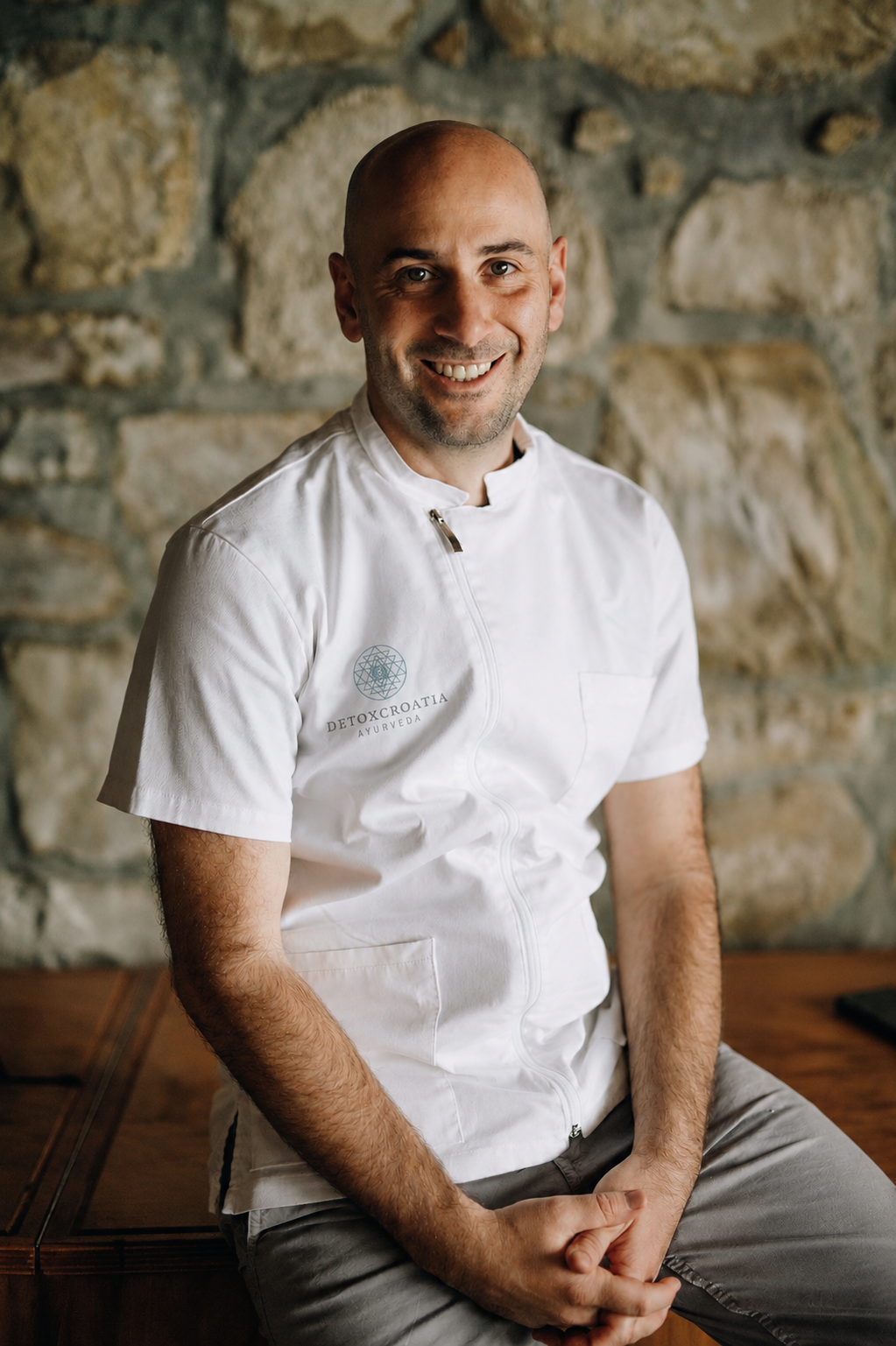
Branko Marković, founder of Detox Croatia, is an Ayurvedic practitioner specialised in Panchakarma and Rasayana therapy. He studied Ayurveda through the Middlesex University of London and College of Ayurveda program, followed by clinical training and practice in India, France, Norway and Croatia. His work is shaped by more than 20 years of individual consultations and guided Panchakarma retreat programs.
The program is not based on a fixed schedule that is applied equally to everyone. It is based on daily guidance. Food, therapies, rhythm, rest, conversation and recommendations are adjusted according to the client's condition.
Some clients enjoy the small community. Some need privacy. Some prefer to stay quiet. Some do not want to talk much. That is respected.
The point is not to perform healing in a group. The point is to create conditions where the body and nervous system can begin to settle.
For many exhausted people, that is already a major intervention.