Burnout recovery retreat Europe is often the search that comes after the holiday did not help.
You took time off. You slept more. You went somewhere quiet. Maybe you travelled, spent time by the sea, booked a calm hotel or promised yourself that this time you would finally recover.
And still, after a few days back home, the same state returned.
The tiredness was still there. The digestion was still sensitive. Sleep was not deep enough. The body felt heavy, but the mind would not stop. You were exhausted, but not truly able to rest.
This is where many people misunderstand recovery.
Deep rest is not only a location. It is a state of the body, mind and senses. When these are stable, a person can feel rest almost anywhere. When they are not stable, even a beautiful place can become another setting where exhaustion continues.
A holiday can remove you from pressure for a few days. It does not necessarily change the inner pattern that pressure has created.
That is why ordinary rest is often not enough after years of stress, responsibility and overstimulation.
What exhaustion actually looks like after years of pressure
Long term exhaustion is rarely just tiredness.
Many clients who come to Detox Croatia describe the same pattern. They are tired, but overstimulated. Heavy, but restless. Slow in the body, but unable to switch off in the mind. They sleep, but do not wake up restored. They eat, but digestion does not feel stable. They try to relax, but the system stays alert.
In Ayurvedic language, this often means that the body is no longer processing well. Food, stress, emotion, irregular rhythm, poor sleep and overwork begin to leave a residue in the system. Ayurveda calls this ama. A simple way to understand ama is this: what the body cannot properly digest, process or clear begins to create heaviness, stagnation and confusion.
First, metabolism slows. Then the nervous system becomes less stable. Then the mind and emotions begin to feel the effect.
At the same time, modern life keeps pushing in the opposite direction. More screens. More decisions. More work. More responsibility. More information. More stimulation.
So the person becomes heavy and wired at the same time.
This is the paradox most burnout retreat pages do not explain. They speak about fatigue or stress, but not about the state where the body is depleted while the nervous system is still switched on.
That is where real recovery has to begin.
Why a holiday cannot solve what years of pressure have built
A holiday removes you from the place where pressure happens.
It does not automatically change the pattern that pressure created.
If digestion is weak, sleep is broken, the senses are overstimulated and the nervous system is still alert, the body may not know how to receive rest. You can lie by the sea and still feel tense. You can sleep ten hours and still wake up tired. You can be in a beautiful place and still feel that something inside is not settling.
This is why many people feel better for two or three days and then collapse back into the same state when they return home.
The rhythm did not change. The digestive pattern did not change. The nervous system did not learn safety again. The body was not guided through a process. It was only removed from its usual environment for a short time.
A holiday may pause the pressure.
A structured recovery process has to work with the body that has been shaped by that pressure.
Why digestion, sleep and emotions often collapse together
In the Ayurvedic view, stress does not stay only in the mind.
It begins as pressure in the nervous system, senses and emotional field, then gradually appears in the body. Digestion is often one of the first places where this becomes obvious: bloating, irregular appetite, constipation, loose stool, heaviness after food, reflux like discomfort or a general feeling that the stomach has become sensitive under pressure.
From there, the pattern can move further. Sleep becomes lighter. The liver feels loaded. The skin reacts. Pain patterns appear. Joints feel stiffer. Mood becomes flat. The person begins to experience all of these as separate problems.
But often they are not separate.
They are different expressions of the same deeper pattern: the body has been carrying too much for too long.
This is why a serious recovery program cannot focus only on relaxation, only on food or only on sleep. It has to look at digestion, nervous system tone, daily rhythm, emotional load, sleep, body strength and the person's real capacity.
What the body needs instead of more rest
Many exhausted people do not need more intervention.
They need fewer demands.
The body needs warmth, rhythm, cooked food, oil therapies, quiet, fewer decisions, fewer screens, fewer strong inputs and a steady daily structure. It needs enough safety to stop defending itself.
This is where an Ayurvedic program differs from a spa break or a generic detox.
The aim is not to push the body harder. Many clients have already pushed themselves for years. The first step is often to create conditions where the system can finally stop fighting.
For some clients, that may include deeper Panchakarma based work. For others, it may mean only gentle procedures, warm food, warm oil, rest, conversation and time. No large detox. No aggressive cleansing. No pressure to perform recovery.
The body decides the intensity of the work.
At Detox Croatia, the process is not applied mechanically. The assessment continues daily: what to do, how to do it, when to do it and when to change direction. Not what is in the protocol. Not what another client received. What this person needs, now.
How Ayurvedic therapies support recovery
Ayurvedic therapies are often presented online as a list of treatments.
Abhyanga. Shirodhara. Swedana. Snehapana. Basti. Virechana.
A list does not explain anything.
The important question is what each technique does inside the whole process and when it is appropriate.
Abhyanga is a warm oil massage used in Ayurveda. It gives the body warmth, rhythm, touch and lubrication. The oils penetrate deep into tissues and into the blood. For a person who has lived in tension for years, this can be one of the first signals that the body is allowed to soften.
Shirodhara is the steady stream of warm oil over the forehead. Traditionally, it is used to calm the mind and support the nervous system. Many clients describe a quietness after Shirodhara that they could not reach through thinking, effort or ordinary rest.
Swedana is herbal steam or heat therapy, usually used after oil treatments. It supports circulation, sweating, muscular release and the movement of what has been loosened by previous therapies.
Snehapana is internal oleation with ghee when appropriate. In a deeper Panchakarma process, it is not done randomly and not by the calendar alone. Ghee binds fat-soluble toxins, including heavy metals and environmental pollutants, and draws them from peripheral tissues towards the digestive tract. The body gives signs when it is ready. Only then can deeper cleansing methods be considered.
Basti is one of the central Ayurvedic procedures when Vata imbalance, bowel rhythm, nervous system overload and deeper cleansing are part of the picture. It is highly individualised and may include herbal decoctions, oils, ghee, honey, salts or other classical Ayurvedic preparations depending on the person and the aim of the treatment.
The difference is not in the names of the therapies.
The difference is in knowing when to use them, how strongly, in what sequence and when not to use them at all.
Panchakarma and Rasayana: cleansing is not the whole story
Detox Croatia is built around Panchakarma principles, but cleansing is not always the whole answer.
Branko Marković is specialised in both Panchakarma and Rasayana therapy. Panchakarma focuses on preparation, cleansing and removal when appropriate. Rasayana focuses on rebuilding: longevity, tissue nourishment, herbs, food, lifestyle and the long term restoration of strength, clarity and vitality.
This distinction matters.
A depleted person does not always need stronger cleansing. Sometimes the system first needs to be rebuilt enough to tolerate deeper work. Sometimes the better choice is warm food, oil, rest, sleep, herbs, daily rhythm and simple guidance.
In Ayurveda, detoxification and restoration should not be separated. If the body is only pushed to clear, but not supported to rebuild, the person may feel more depleted.
This is one reason many aggressive detox programs fail exhausted people.
They treat cleansing as the goal.
In a serious Ayurvedic process, cleansing is useful only when the body is ready and when restoration is also part of the plan.
Why some clients need less, not more
This is one of the most important points.
Not every exhausted client should receive a strong detox.
Some people arrive in a state where the body is too depleted, too nervous, too dry, too unstable or too overwhelmed for deeper cleansing. In those cases, more is not better. More can make the person worse.
For those clients, the program may be very simple: warm cooked food, gentle oil therapy, rest, sleep, calm conversation, short walks, breathing, daily rhythm and enough space to feel safe.
That may not look dramatic.
But for the body, it can be the first real recovery in years.
This is where individual assessment matters. A fixed program may look good on paper, but a tired body does not care about a schedule. It responds to what it can actually handle.
What a structured retreat actually means
A structured retreat is not the same as a crowded schedule.
At Detox Croatia, structure means that the client does not have to manage the process alone.
The groups are small, usually four to eight people. This is not only a comfort detail. It changes the quality of observation, care and adjustment.
Some clients need contact with the group. They feel supported by other people going through a similar process. Others need privacy, silence and almost no social demand. Both are respected.
A person does not have to perform recovery.
They do not have to be social. They do not have to join every conversation. They do not have to explain themselves all the time. Some clients spend time with others. Some stay mostly alone. The program allows both.
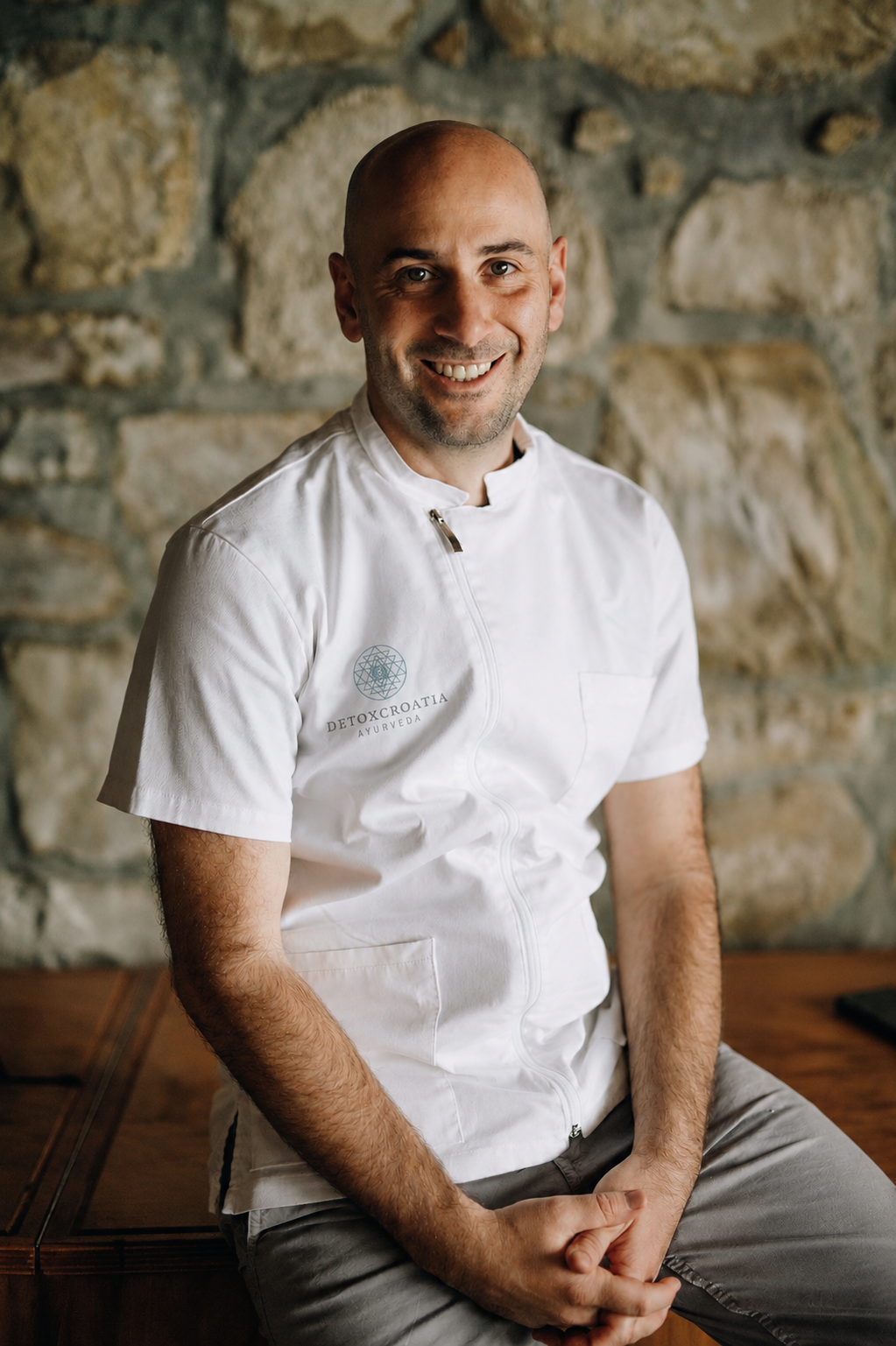
Branko Marković, founder of Detox Croatia and Ayurvedic practitioner, is present throughout the program. Guidance does not happen only at the first consultation. It continues daily through observation, small adjustments, conversation, food advice, rhythm correction and practical education.
The education is not delivered as heavy lectures.
It happens naturally: what to eat, how to rest, how digestion responds, what the body is showing, what to continue at home and what to avoid after the retreat.
This daily presence is one of the main differences between a guided Ayurvedic retreat and a resort package.
The client is not left alone with a printed schedule.
What clients often notice in the first three to four days
The first changes are usually simple.
Sleep becomes deeper. The stomach feels calmer. The head feels quieter. There is more space between thoughts. The body starts to feel warmer. The constant inner pressure begins to reduce.
Often, after five or six days, people look visibly different. The face becomes clearer. The eyes look less strained. The body seems less collapsed.
This is not a cosmetic promise.
It is something often observed when sleep, digestion, warmth, oil therapies, food rhythm and reduced pressure begin to work together.
One client from the Netherlands, a high profile manager in a large technology company, arrived with almost no energy, poor digestion, anxiety, low mood and a feeling that life had lost its force. After seven days, his own words were that he had not felt like that for thirty years: fresh, light, mentally rested, relaxed and alive again.
That was not because one treatment changed everything.
It was because the whole environment changed the message his body was receiving every day.
"Less pressure. More rhythm. Warm food. Oil. Rest. Guidance. Nature. Human presence without demand."Senior manager, Netherlands — 7-day program, Rab Island
When 7 days is a start and when 14 days is needed
A seven day Ayurvedic retreat can be enough for a first reset.
It can help the person step out of the old rhythm, calm the system, improve rest, support digestion, receive daily therapies and understand what has been driving the exhaustion.
For many clients, seven days is the first real interruption of the pattern.
Fourteen days allows a deeper process.
There is more time for preparation. More time for the body to respond. More time for Snehapana when appropriate. More time for Basti or other Panchakarma based procedures if the person is ready. More time for the nervous system to stop expecting pressure every day.
For long standing patterns, one retreat should not be seen as a complete solution. Some clients benefit more from repeating the process seasonally or returning when the body begins to lose rhythm again.
The effect of a retreat can last for months when the client follows food, sleep, lifestyle and rhythm recommendations after returning home. When a person goes immediately back into the same pressure, the effect naturally fades faster.
Recovery is not only what happens during the retreat.
It is also what the client protects afterwards.
Why Rab Island and Plitvice Lakes support the process
The location is not decoration.
Rab Island gives the body sea air, Mediterranean plants, light, swimming, walking and a slower island rhythm. Rab has a long medical history as a site for respiratory recovery, with air quality distinct from most European urban environments. For people who arrive from offices, screens and constant responsibility, that change of environment matters.
Plitvice Lakes offers another kind of support: forest, water, waterfalls, walking, silence and the direct physical experience of nature. Walking in that environment has measurable effects on the body, independent of any treatment.
Neither location is presented as a cure.
The point is simpler: when the surroundings become quieter, cleaner and more natural, it becomes easier for the body to stop reacting to pressure all day.
Ayurveda works best when the environment supports the treatment.
When a retreat is not enough and a doctor is needed
A burnout recovery retreat is not a replacement for medical diagnosis, medical treatment or psychological care.
If there are serious, acute or chronic symptoms, a doctor comes first.
Medical consultation is especially important in cases of unexplained weight loss, blood in stool, severe abdominal pain, persistent vomiting, fever, severe depression, suicidal thoughts, active cancer treatment, complex medication, pregnancy, severe weakness, eating disorders or any unstable medical condition.
Clients dealing with serious illness or recovery from medical treatment may consider Detox Croatia only as supportive care, never as a replacement for prescribed treatment.
The role of the program is to support rest, rhythm, digestion, strength, emotional stability and quality of life where appropriate.
It is not a medical cure.
Is Detox Croatia suitable for burnout?
Detox Croatia may be suitable for people with burnout symptoms when they need a structured, quiet and guided environment rather than another short break.
It is especially relevant for people who feel chronically exhausted, overstimulated, digestively sensitive, sleep disturbed, emotionally flat or unable to recover through ordinary rest.
The program is small, individualised and based on Ayurvedic assessment. The goal is not to push the person through a fixed protocol, but to understand what the body can handle and what kind of support is needed first.
For some clients, that means Panchakarma based cleansing.
For others, it means food, warmth, oil, sleep, calm therapies and Rasayana support for rebuilding.
The right question is not: how strong can the detox be?
The right question is: what does this person need now?
If rest has stopped working, the answer is not always more rest.
Sometimes the body needs a different message.
Warmth instead of pressure. Rhythm instead of stimulation. Food instead of depletion. Oil instead of dryness. Guidance instead of guessing. A small group instead of anonymity. Silence instead of another schedule full of demands.
Burnout recovery is not about escaping life for a few days.
It is about helping the body remember how to receive rest again.
To learn more, see the 7 and 14-day Ayurvedic retreat program in Croatia, or read more about stress and digestion and why aggressive detox can be too much for an exhausted body.